Quick Answer
• Determinate (bush) tomatoes are genetically programmed to reach a fixed height—compact bush varieties stop at 24 to 30 inches, while standard determinate types cap out at around 4 to 5 feet—yielding their entire crop in a highly concentrated 3-to-5-week window. They require strict zero-pruning of fruit-bearing stems, and container growers should use a minimum 5-gallon pot for dwarf varieties, or 8 to 10 gallons for standard determinate plants.
• Indeterminate (vining) tomatoes grow continuously, requiring aggressive pruning down to 1 or 2 main stems and heavy-duty 6-foot staking to manage endless foliage and maximize a continuous harvest until frost.
• Choosing the wrong growth habit for your specific space—or applying the wrong pruning technique—will result in stunted plants, severe disease pressure, or a complete loss of yield.
We have all been there. You visit a garden center in the spring, grab a beautiful little tomato seedling, and plant it in your raised bed. Two months later, one of two things happens: either the plant mysteriously stops growing right when summer hits its peak, or it turns into a massive, 8-foot-tall jungle monster that completely swallows your garden.
The difference isn’t how much you watered or what fertilizer you used. The difference is written right into the plant’s DNA.
When you buy a tomato plant, the most important word on the plant tag isn’t the variety name—it is whether the plant is Determinate or Indeterminate. If you don’t understand the biological difference between these two growth habits, you will end up pruning away your harvest, using the wrong support system, and ultimately setting yourself up for failure.
Here is the hard science behind how these two types of tomatoes grow, and exactly which one you should choose for your garden goals. (If you are looking for the complete A-to-Z roadmap, be sure to bookmark our master class: How to Grow Tomatoes: The Complete Guide from Seed to Harvest).
What is a Determinate Tomato? (The “Bush” Type)
Determinate tomatoes (like ‘Roma’ or ‘San Marzano’) are genetically capped at a fixed height based on their cultivar. Compact bush varieties typically stop at 24 to 30 inches (per University of Minnesota Extension), while standard determinate types cap out at around 4 to 5 feet (per University of Vermont Extension), yielding their entire fruit crop in a concentrated 3-to-5-week window.
By synthesizing morphological growth data from the University of Minnesota Extension and the University of Vermont Extension, I apply the Terminal-Bud Yield Strategy—a methodology that leverages the plant’s natural biological limits to maximize harvest efficiency without risking disease.
The Biological Truth: The Terminal Bud Limit A determinate tomato is genetically programmed to grow to a predetermined height. Once the main stems reach this genetic limit, the growing tip (the terminal bud) stops producing leaves and exclusively forms a final flower cluster. At this point, vertical growth completely stops. The plant shifts its energy into turning those existing flowers into fruit.
The Harvest Window: Concentrated Yield Because the blossoms develop at the same time, the fruit ripens in a highly concentrated window of approximately three to six weeks. You will get a massive harvest all at once. After that heavy yield, the plant’s active production cycle is effectively over.
Spacing & Container Science For optimal airflow, the Cornell University College of Agriculture and Life Sciences establishes a rigid spacing baseline of 12 to 24 inches apart for determinate varieties. When container gardening, cross-referencing soil volume data from NC State Extension, the University of Maryland Extension, and Penn State Extension reveals a tiered approach to root health. While dwarf determinate varieties can survive in a bare minimum 5-gallon container with a 12-to-24-inch depth, standard determinate plants require 8 to 10 gallons of growing media with a depth of 12 to 16 inches to maximize yield. To ensure adequate root oxygenation and moisture retention during peak summer heat, you should ideally upgrade to a pot that is at least 20 inches wide.
Are you strictly growing on a patio or balcony? Sizing the pot is only half the battle. Discover my Dual-Baseline Strategy, how to prevent container heat-stress, and the exact cultivars you need in my deep-dive guide: Best Tomato Varieties for Containers and Small Spaces (Stop Planting Giants in Pots!)
Best For:
- Container Gardening: Their compact size makes them the absolute best choice for patio pots and urban spaces.
- Preserving and Canning: If you want to make batches of tomato sauce or salsa, you need high volume instantly. Determinate varieties deliver exactly that.
What is an Indeterminate Tomato? (The “Vining” Type)
Indeterminate tomatoes (like ‘Beefsteak’, ‘Cherokee Purple’, or ‘Early Girl’) are true vines that grow continuously to heights of 3 to 5 feet or more, producing a steady trickle of fruit until killed by a hard frost.
Unlike bush types, managing these vines requires the Apical Dominance Control Protocol—a structural and pruning strategy critical for disease prevention.
The Biological Truth: Continuous Apical Dominance Indeterminate tomatoes never form a terminal flower cluster on their main stem. The main growing tip will continue to produce new leaves, stems, and flower clusters on side branches indefinitely. The plant will literally keep growing taller and wider until the weather becomes too cold.
The Support Mandate: Heavy Infrastructure You cannot let indeterminate tomatoes sprawl without risking massive disease pressure. Data from Cornell University dictates that these vines require serious infrastructure: wooden stakes must be roughly 6 feet long, 1 ½ inches square, and driven at least 8 to 10 inches deep into the soil at transplanting to avoid root damage. Alternatively, the Colorado State University Extension recommends heavy-duty wire cages measuring two feet across and five feet tall to allow for adequate air circulation.
Best For:
- Fresh Eating: If your goal is a steady supply of fresh tomatoes for salads from mid-summer into late fall, vining types are your go-to.
- Long Growing Seasons: In warmer zones, an indeterminate vine will maximize your total yield over the entire extended season.
The Golden Rule of Pruning (The Myth-Buster)
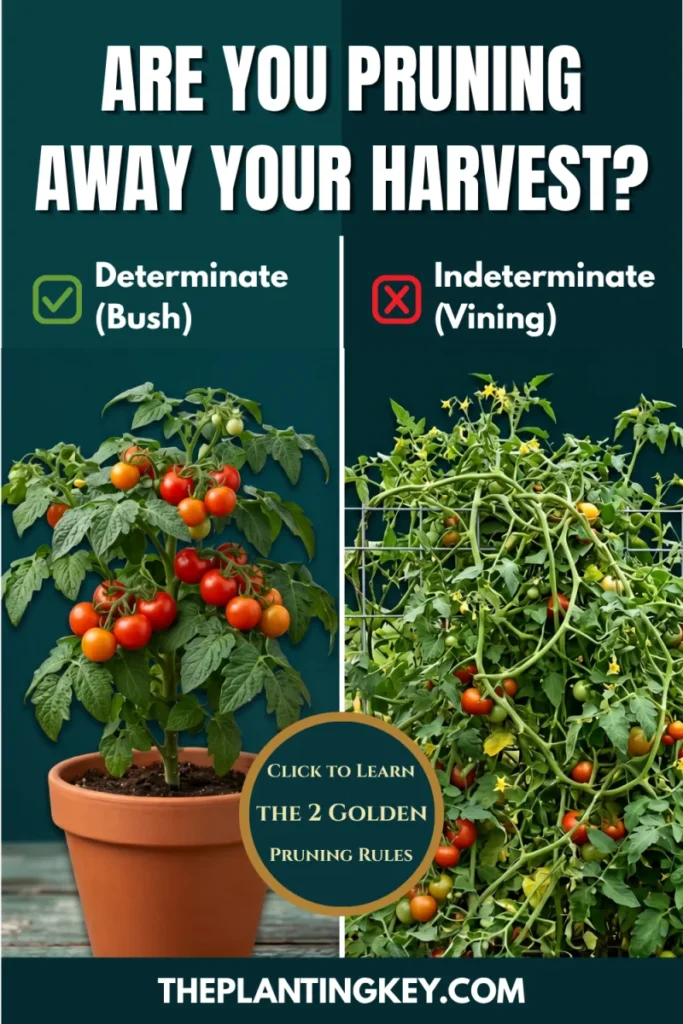
This is where most gardeners make a fatal mistake. You cannot treat these two types of plants the same way, especially when dealing with “suckers” (the small shoots growing in the “V” joint between the main stem and a leaf branch).
- Rule #1: NEVER Prune a Determinate Tomato’s Canopy. Because a determinate plant sets a fixed amount of fruit, pinching off suckers quite literally cuts off your future harvest. Pruning should be strictly limited to removing the lowest leaves touching the soil to prevent soil-borne diseases like Early Blight from splashing up during heavy rains.
- Rule #2: Indeterminate Tomatoes MUST Be Pruned (The 1-2 Stem Protocol). An unpruned indeterminate vine turns into an impenetrable, diseased mess. Maintain aggressive pruning down to just one or two vigorous main stems by snapping off suckers when they are 2 to 4 inches long. Furthermore, to accelerate late-season ripening, you should remove the growing tips of the main stems about a month before your first expected frost, forcing the plant’s energy into existing fruit. (Pro-Tip: Always disinfect your pruning shears with 70% isopropyl alcohol or a 10% bleach solution before cutting to prevent disease transmission).
Master Summary Table: The Genetic Growth & Management Matrix
| Growth Habit | Biological Limit | Harvest Window | Pruning Protocol | Required Support |
| Determinate (Bush) | 24″–30″ (compact) / up to 4–5 ft (standard) | 3 – 5 Weeks (Concentrated) | Lower leaves only (No suckers) | None, or small 3ft cages |
| Indeterminate (Vining) | Continuous (Until Frost) | Continuous (Slow Trickle) | Aggressive (Maintain 1-2 main stems) | 6ft deep-driven stakes / 5ft cages |
Which One Should You Choose? (The Decision Matrix)
Still not sure which one to plant? Use this quick matrix to make your decision:
- The Container Strategy: If you are growing in 5-gallon buckets, 20-inch patio planters, or urban balconies: Choose Determinate. (Need specific cultivar recommendations and exact pot sizing charts? Check out my dedicated guide: Best Tomato Varieties for Containers and Small Spaces).
- The Infrastructure Strategy: If you are building an 8-foot tall trellis, driving deep stakes, or using the “Florida Weave”: Choose Indeterminate.
- The Preservation Strategy: If you want to make 20 jars of pasta sauce in one single weekend: Choose Determinate (look for paste varieties like ‘Roma’ or ‘San Marzano’).
- The Fresh-Eating Strategy: If you want fresh slicing tomatoes for your burgers all summer long: Choose Indeterminate (heirloom vines like ‘Beefsteak’ or ‘Cherokee Purple’ are ideal).
- The Short-Season Strategy (Zones 4-5): If you live in a colder climate and need to guarantee a fully ripened harvest before an early fall frost strikes: Choose a fast-maturing Determinate.
Pro Tip: You don’t have to choose just one! The most successful gardeners use a hybrid strategy. I always plant a row of determinate paste tomatoes for my canning needs, alongside a few indeterminate heirloom vines for fresh summer eating.
You Have Your Strategy. Now What? (The Execution Phase)
Understanding the biology of your tomato plant is the first major step toward a massive harvest. You now know exactly how your plant is programmed to grow and the precise pruning protocols required to keep it disease-free.
But knowing what to plant is only half the battle. Knowing exactly when to put it in the ground based on your local soil temperatures, and how to execute the strict spacing requirements, is what separates struggling beginners from master gardeners.
Your Next Steps:
- Want the complete A-to-Z system? Master every stage of the growing cycle with our ultimate pillar guide: How to Grow Tomatoes: The Complete Guide from Seed to Harvest.
- Ready to map out your planting dates? Start executing your plan today with our specific timing protocols: When to Plant Tomatoes: The Ultimate Zone-by-Zone Guide.
- Implement a Stage-Based Feeding Protocol. Understanding your plant’s DNA is the first step; feeding it is the second. Learn how to adjust your fertilizer strategy as your plants transition from vegetative growth to heavy fruit production. Read: The Best Fertilizer for Tomatoes: When, How, and What to Feed Them.
Behind the Data & Research Sources
To ensure practical accuracy, the strategies and recommendations in this guide are based on agricultural extension research and informed by established plant science principles, including:
- University of Minnesota Extension: Growing tomatoes in home gardens
- University of Vermont Extension: How to Prune Tomato Plants
- Cornell University College of Agriculture and Life Sciences: Tomato growing guide
- NC State Extension: 18. Plants Grown in Containers
- University of Maryland Extension: Types of Containers for Growing Vegetables
- Penn State Extension: Container Vegetable Gardening – Four Keys to Success
- Colorado State University Extension: Growing Tomatoes