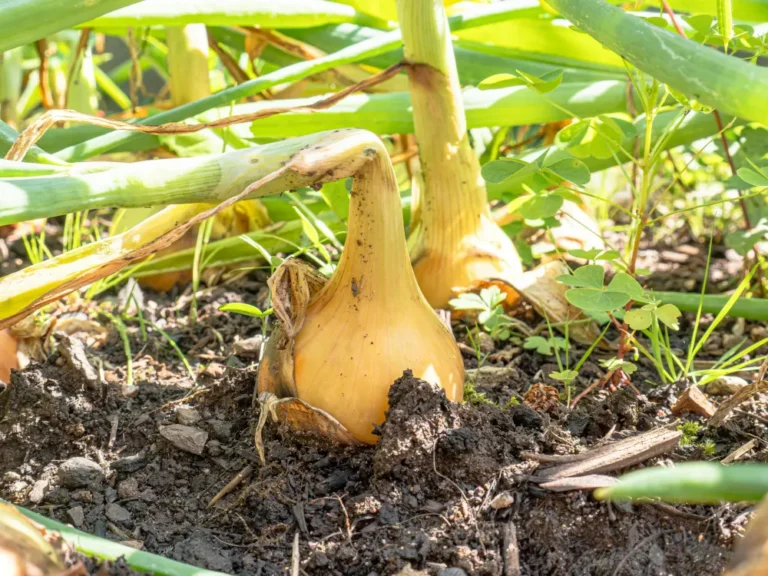
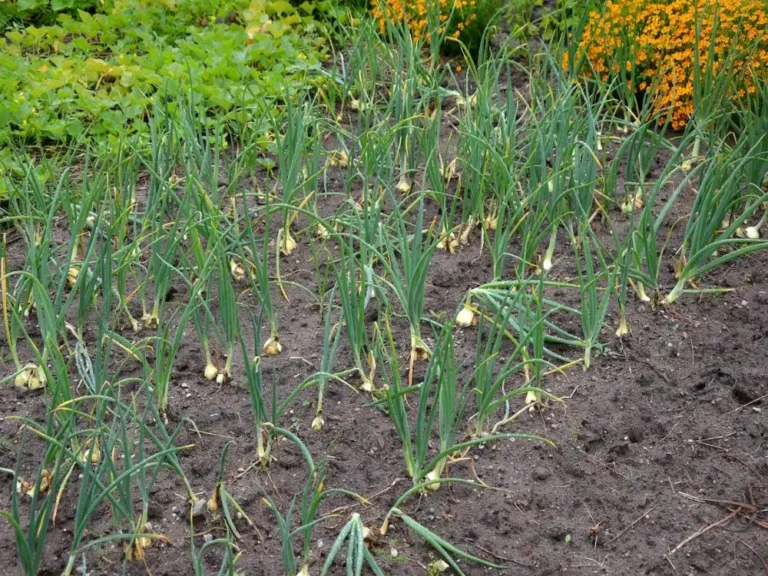
Hello, I’m Yun, founder of The Planting Key. I know the feeling. You walk out to your garden expecting to see lush green leaves, but instead, you see a stiff, tall stalk with a teardrop-shaped bud on top.
Your onion is blooming. In gardening terms, it has “bolted.”
For a flower gardener, blooms are a success. For an onion gardener, they are a sign that the plant has “panicked.” Many beginners think they can just cut the flower off and the bulb will keep growing. Unfortunately, this is a myth.
Here is the complete guide on why this happens, how to salvage your harvest, and how to prevent it next year.
Quick Answer: Can you eat an onion that has flowered?
Yes, but you must act fast. Once an onion sends up a flower stalk (a process called “bolting”), the bulb stops growing and will soon become tough.
- The Rule: Harvest it immediately.
- The Use: It will not store. Cut out the tough central stalk and use the rest of the onion within 1-2 days.
- The Cause: It is usually a stress response to temperature fluctuations or planting sets that were too large.
The Immediate Action: What to Do Now?
If you see a flower stalk, the onion’s life cycle as a bulb-producer is over. No amount of watering or fertilizer will turn it back.
Step 1: Harvest Immediately Do not wait for the top to fall over (unlike a healthy crop, where “falling over” is the sign to pick—see my guide on When to Harvest Onions). Pull the onion now. The longer the flower grows, the more energy it sucks from the bulb, and the tougher the onion becomes.
Step 2: The “Kitchen Surgery” When you cut open a bolted onion, you will see a thick, solid ring in the center. This is the base of the flower stalk.
- Texture: This central core is woody, tough, and unpleasant to eat.
- Flavor: The rest of the onion is safe to eat, though the flavor may be slightly stronger or more pungent than usual.
Step 3: Eat It Fast (Do Not Store) Bolted onions are “use-it-or-lose-it” produce. The flower stalk goes right through the center of the onion, and Michigan State University confirms this eliminates the bulb’s storage life entirely. The open channel where the stalk grew allows moisture and bacteria to enter, causing the onion to rot from the inside out. If you try to cure and store these onions, they will rot within weeks and could spread rot to your healthy onions.
- Cooking Tip: Slice the onion, pop out the tough center ring (compost it), and sauté the rest for dinner tonight.
The Science: Why Did My Onion Bolt?
To stop this from happening, you must understand the onion’s biology. Onions are biennials. This means they have a 2-year life cycle:
- Year 1: Grow a bulb (to store energy for winter).
- Year 2: Use that stored energy to make a flower and seeds.
The “Panic” Mechanism: When an onion bolts in its first year, it is because it was tricked. Stressful weather conditions convinced the young plant that “Winter has already passed, and it is now Year 2.” The plant panics, skips the bulb-building phase, and rushes directly to reproduction (flowering) to ensure its survival.
The 3 Main Causes of Bolting
If your onions are flowering, one of these three culprits is to blame.
Cause 1: The “False Winter” (Temperature Stress)
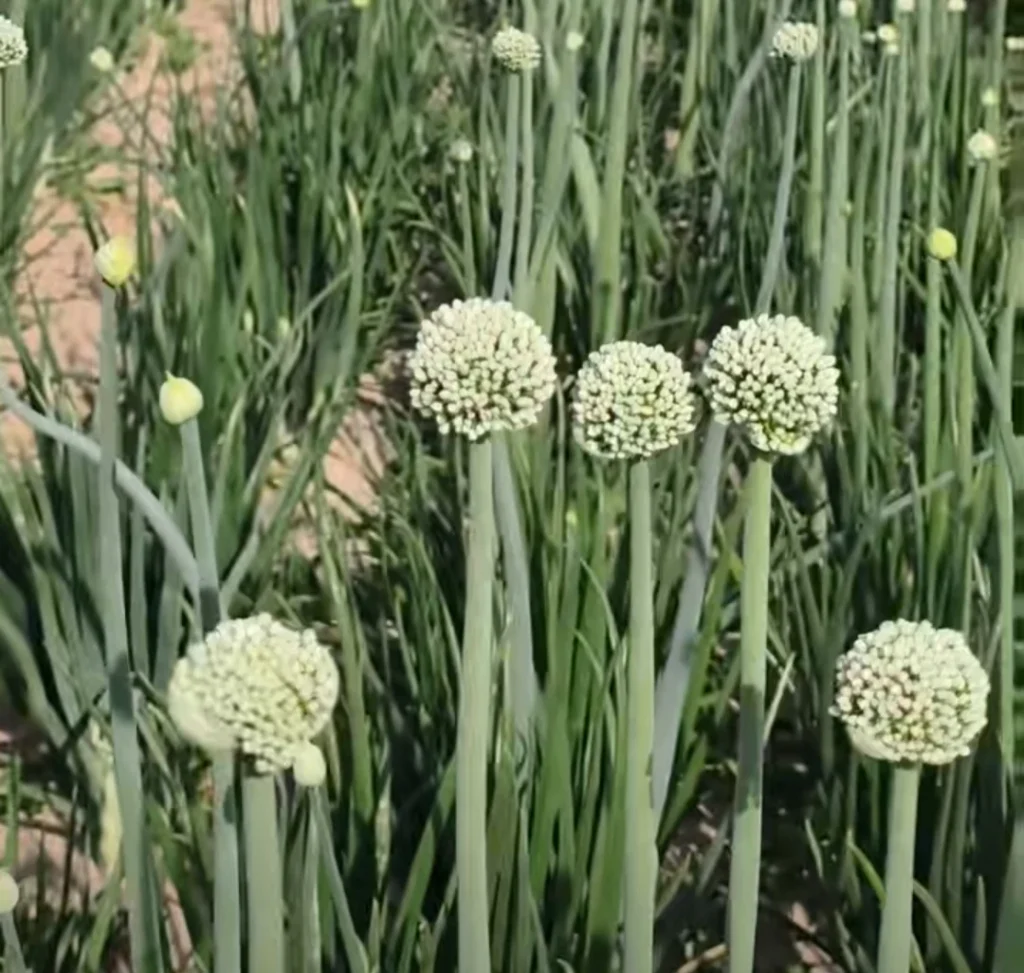
This is the most common cause. If you plant your onions too early in spring, and they are hit by a prolonged cold spell (usually below 50°F / 10°C for several days or more), the plant gets confused. Michigan State University confirms this temperature threshold triggers bolting once the plant reaches the critical five-leaf stage—and the longer the cold exposure, the higher the risk. The onion thinks the cold spell was “Winter” and that it is now time to reproduce.
- The Fix: Planting time is critical. You must wait until the risk of hard, prolonged cold has passed.
- Read my guide: When to Plant Onions in Zones 4-9 to find the precise, safe window for your region.
Cause 2: The “Size Trap” (Sets Too Large)
This is the #1 mistake beginners make when buying onion sets.
Why does size matter? Research from Michigan State University reveals a specific biological trigger: an onion plant usually needs to reach the five-leaf stage before it is sensitive to cold.
- Large Sets (> 5/8 inch): Because they are huge, they hit this critical “five-leaf” maturity while the spring weather is still cold (below 50°F). This tricks the plant into thinking winter has passed, triggering it to flower.
- Small Sets (< 5/8 inch): Utah State University recommends choosing sets smaller than 5/8 inch in diameter — about the size of a dime. These stay immature during the cold snaps and remain safely in “bulb-growing mode.”
The Fix: Sort your sets. Plant the small ones for bulbs. Use the big ones only for green onions (read my guide on How to Grow Green Onions to see how I do this).
Cause 3: Water Stress (The Summer Trigger)
While cold triggers bolting in spring, drought triggers it in summer. Onions have shallow roots. If the soil goes bone-dry in hot weather, the plant goes into survival mode: “I’m going to die! I better make seeds now!”
- The Fix: Keep soil consistently moist.
- Read my guide: How to Grow Onions for my “1-inch water rule” and mulching tips.
Can I Just Cut the Flower Off?
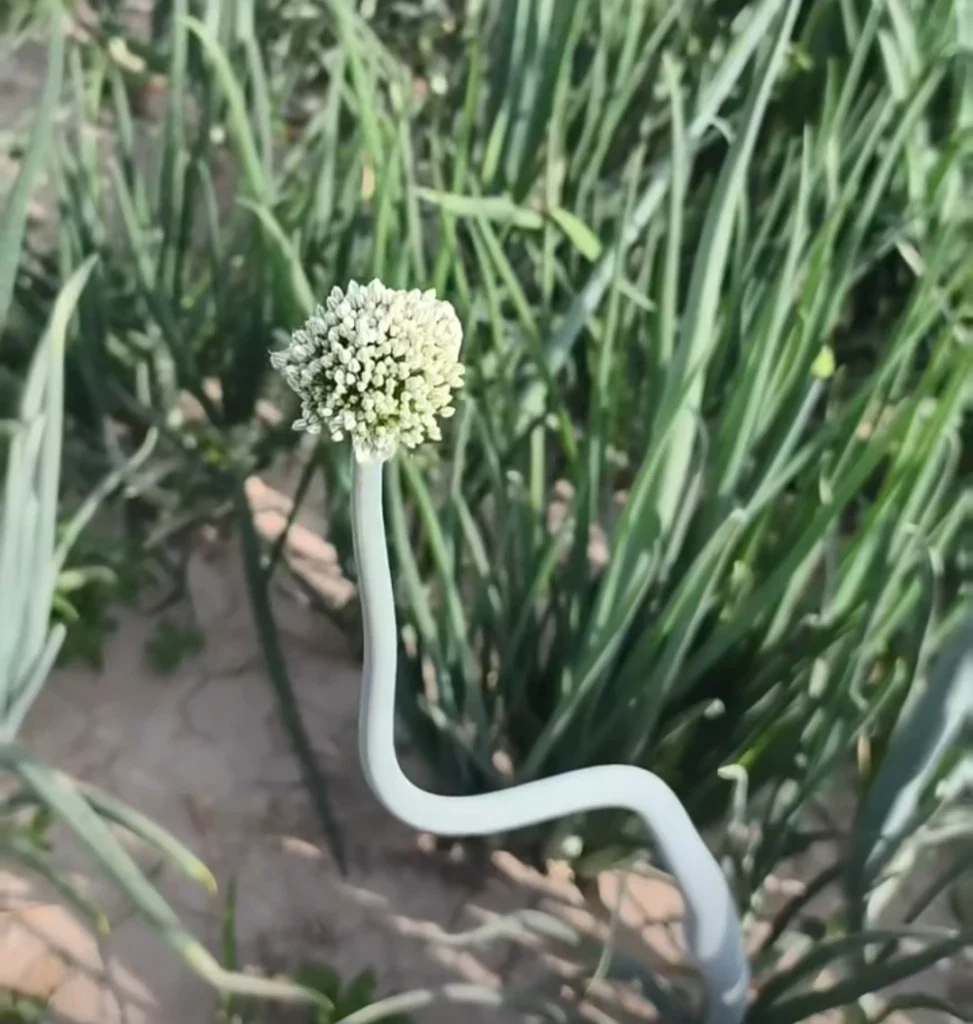
I hear this advice often: “Just snap the flower head off, and the bulb will keep growing.”
This is a myth.
While snapping the head off stops the plant from putting energy into seeds, the damage is already done.
- Bulb Size Stunts: Iowa State University Extension confirms that flowering plants “do not form good-sized bulbs” and recommends using them immediately as green onions rather than waiting for a harvest that won’t happen.
- Internal Texture: The hormonal shift has already created a thick “stalk” inside the bulb. Even if you cut the flower, the quality of the bulb is compromised, and the center will remain woody and tough.
The Verdict: Do not try to save it. Harvest it now and eat it.
Prevention Checklist for Next Year
You can’t control the weather, but you can control these factors to reduce bolting by 90%:
- Switch to Transplants: As I explain in my How to Grow Onions guide, live seedlings (transplants) are biologically younger and less prone to bolting than sets.
- Protect from Cold: If you planted early and a hard freeze is forecasted, cover your crop with a floating row cover to buffer the temperature shock.
- Sort Your Sets: If you use sets, throw out the big ones (or eat them as green onions). Only plant the dime-sized ones.
Your Next Step
Now that you’ve salvaged your bolted onions for tonight’s dinner, it’s time to ensure the rest of your crop makes it to the finish line without the same fate. Learn how to manage water and soil to prevent stress in my main guide: How to Grow Onions: The Complete Guide from Seed to Harvest