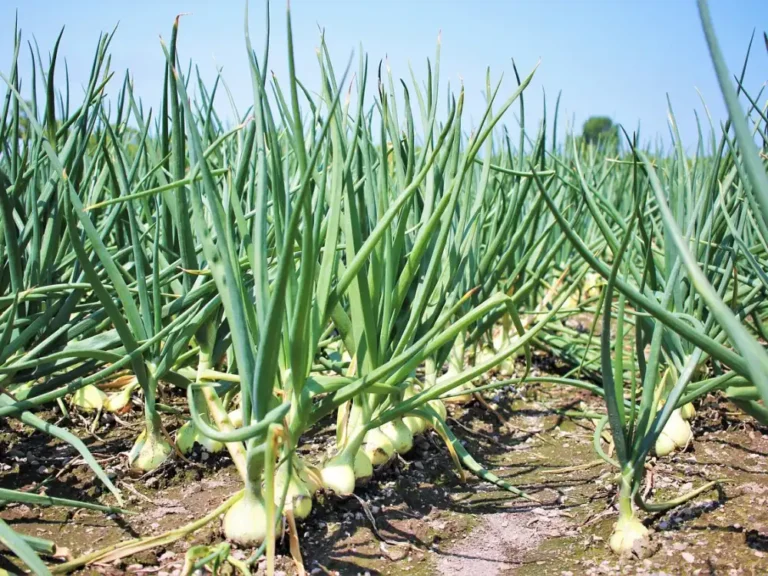
You spent months nurturing them. You watered them. You weeded them. You dreamed of pulling up massive, sweet onions that would last you through the winter.
But when you walk out to the garden, reality hits. The leaves are turning yellow way too early. Is the plant dying, finishing its job, or crying out for help?
First, take a deep breath. You are not alone.
I have been there. My first year growing onions, I panicked when the leaves started turning yellow in July. I had no idea if my plants were finally maturing or if a hidden disease was destroying them from the roots up. It’s frustrating, but here is the good news: Onions are incredibly honest plants. Every symptom—especially yellowing leaves—is a signal. They are telling you exactly what is wrong.
If you’re new to growing onions or want a complete overview of the entire process, check out my guide: How to Grow Onions. This article focuses specifically on diagnosing and solving the yellowing leaf problem.
In this guide, I use a scientific approach to explain the reasons why onion leaves turn yellow. I have referenced research from the University of California IPM (UC IPM) and the University of Minnesota Extension to help you accurately diagnose problems in your garden. To assist with your visual identification, you can view high-resolution symptom images and diagnostic keys directly on their official websites.
The Key to Diagnosis: Where Does the Yellowing Start?
Before we dive into the details, use this Quick Diagnostic Check to narrow down the culprit:
- Yellowing from tips down + plants flopping over → Maturation (Good news!)
- Yellowing from tips down + plants still upright → Stress or fungal disease
- Yellowing from base up + twisted leaves → Viral issue (like Yellow Dwarf)
- Entire plant pale green to yellow + thin stems → Nitrogen starvation
Scenario 1: The “Good” Yellow (Maturation)
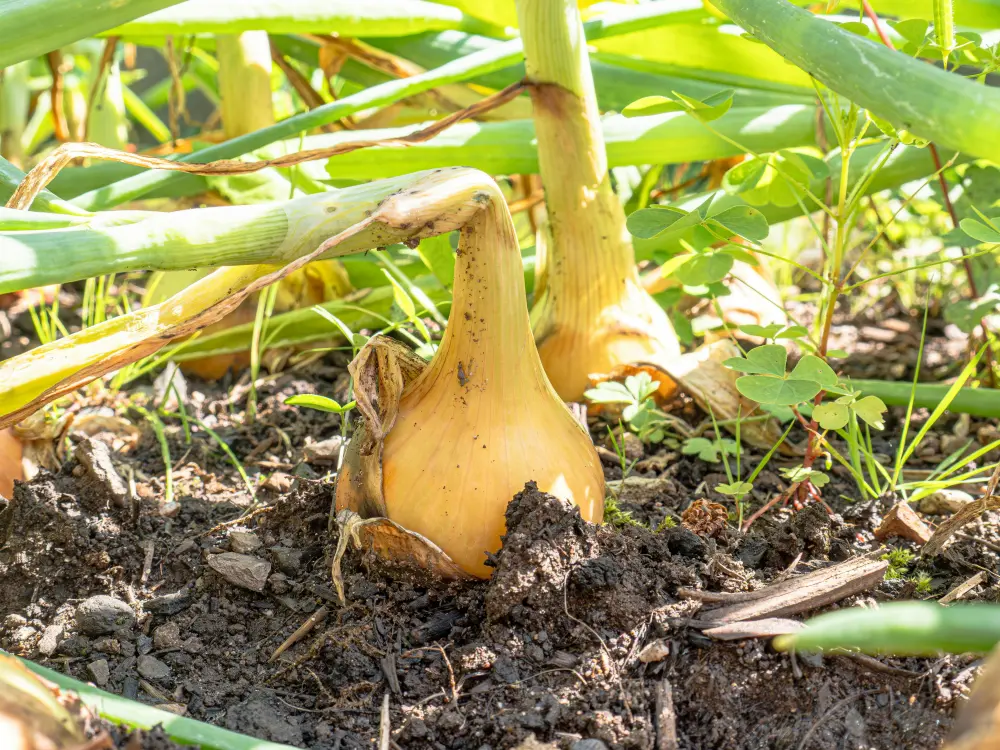
Timing: Mid-to-Late Summer
If you see yellowing leaves in late summer and the tops are starting to flop over, celebrate. This is not a problem—it’s a milestone.
The Look: Leaves lose their deep green color and naturally bend at the neck. The whole plant looks like it’s taking a bow.
The Science: The plant is stopping leaf production and transferring all that energy down into the bulb to seal it off for dormancy. According to the Penn State Extension, the optimal harvest window for bulb onions is when about 33 to 50 percent of the tops have fallen over.
Action: Stop watering immediately. You are approaching the harvest window.
Read More: Unsure if it’s time to pull? Don’t guess. Check my guide: When to Harvest Onions.
Scenario 2: The “Bad” Yellow (Environmental Stress)
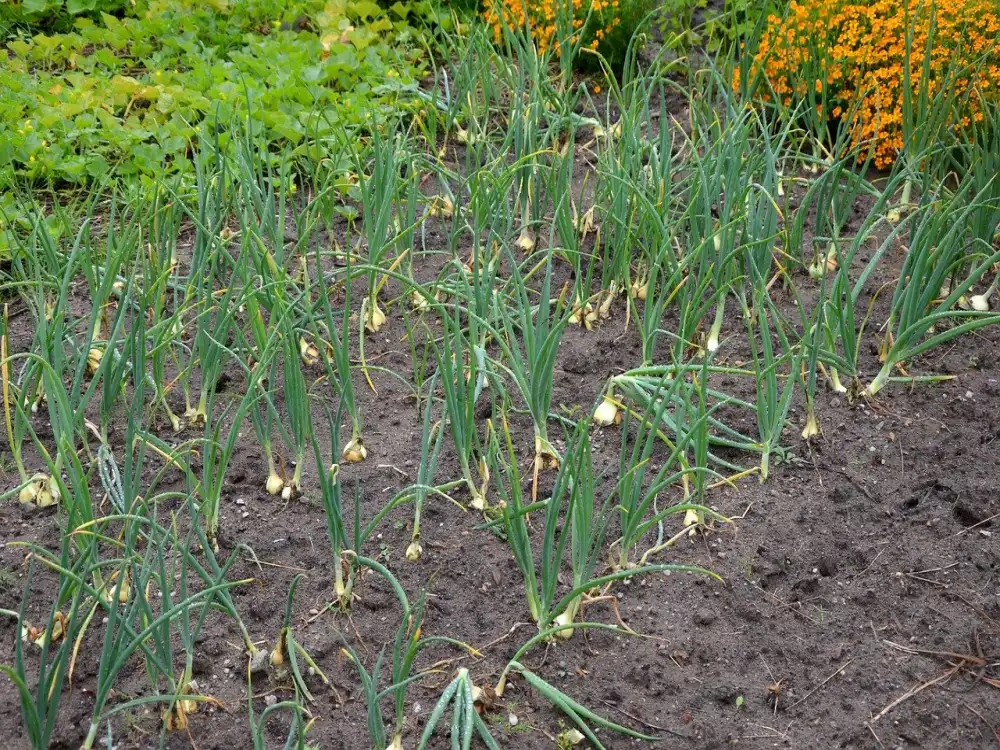
Timing: Spring or Early Summer (while plants are still actively growing)
If your onions turn yellow while they are still young and standing upright, you have a problem. Onions have a very shallow, inefficient root system. They are terrible at scavenging for water and nutrients on their own.
Nitrogen Deficiency: The “Pale, Thin” Look
What You’ll See:
- The entire plant appears pale green to yellow (not the deep blue-green of a healthy onion)
- Stems are noticeably thin and weak
- Yellowing starts at the tips of the leaves and works its way down
According to the University of Minnesota Extension, these three signs together—pale color, thin stems, and tip yellowing—are the classic signature of nitrogen deficiency.
Why It Happens: Onions are heavy feeders. If you didn’t fertilize early enough or if your soil is depleted, the plant simply runs out of fuel during the critical leaf-building stage.
Action: Apply a quick-release nitrogen fertilizer immediately (blood meal, fish emulsion, or a balanced vegetable fertilizer). Water it in well.
Prevention Tip: Timing your planting correctly and preparing soil in advance can help prevent nutrient deficiencies. Learn the optimal planting windows for your zone in my guide: When to Plant Onions: Exact Calendar for Zones 4-9.
Water Stress: The “Tip Dieback” Look
What You’ll See:
- Progressive yellowing and dieback starting specifically from the leaf tips
- The rest of the plant may still look green, but those tips are crispy and brown
- Soil is dry more than an inch down
Why It Happens: Onions cannot handle drought. Their roots are shallow and weak. If the soil dries out, they yellow from the tips down as the plant sacrifices outer leaves to survive.
Action: Water deeply and consistently. Onions need about 1 inch of water per week during the growing season.
Note: Container-grown onions are especially vulnerable to water stress. If you’re growing in pots, see my specialized guide: How to Grow Onions in Pots.
Scenario 3: The “Big Three” Diseases (Fungal Infections with Spots, Fuzz, and Rot)
Timing: Any time
If the yellowing comes with extra clues—spots, fuzz, twisted growth, wilting, or visible bugs—you are dealing with a pathogen or pest.
Botrytis Leaf Blight
What You’ll See:
- Small, white, sunken oval spots on leaves
- Each spot is surrounded by a light green or silvery-white “halo”
- The centers of the spots become straw-colored and may split lengthwise
- When spots become numerous, the leaf tips die back
When It Strikes: Cool, wet weather. According to the University of California IPM, Botrytis develops when leaves stay wet for 20 hours or more, with spores germinating around 59°F and peak fungal growth at 73-77°F.
Action: Remove infected leaves. Space plants well to improve air circulation. Practice a 3-year rotation away from onions and garlic.
Downy Mildew
What You’ll See:
- A fine, furry, grayish-white to purple growth on the surface of older leaves
- The leaf tissue underneath turns pale green, then yellow, then collapses
- Large, yellowish, circular clumps of infected plants (often spread in the direction of prevailing winds)
When It Strikes: Cool, moist conditions. Downy mildew can explode into an epidemic if humidity is high and temperatures are between 43 and 80°F.
Action: Use disease-free bulbs and seeds. Improve drainage. Allow plants to dry between waterings. Practice 3-4 year crop rotation.
Fusarium Basal Rot
What You’ll See:
- Progressive yellowing and dieback from the tips down
- The plant feels loose in the soil and pulls up easily
- Roots are dark brown to dark pink
- A watery brown decay at the base of the bulb
- White fuzzy fungal growth on the rotted basal plate
The Diagnostic Test: Pull one up. Cut the bulb vertically. If the base shows brown discoloration and the roots are brown or pink, it’s Fusarium.
This fungus survives indefinitely in soil, so prevention is critical.
Action: Remove and destroy infected plants (trash, not compost). Do not plant onions, garlic, or related crops in this spot for at least 3-4 years. Plant in cool weather and avoid transplanting (direct seeding reduces infection risk).
Pink Root
What You’ll See:
- Leaves turn yellow with a reddish tinge from the tip down
- Sunken dark pink to maroon areas on the roots
- Infected roots break off easily when you pull the plant
- Plants are stunted and produce very small bulbs or none at all
When It Strikes: Mid-to-late season, especially in areas with poor soil conditions.
Pink root is a common culprit behind yellowing in struggling plants.
Action: Improve soil drainage and fertility. Practice crop rotation. There is no cure once infection occurs—focus on prevention for next year.
Scenario 4: The “Silent” Destroyers (Soil-Borne & Secondary Issues)
White Rot (The 20-Year Threat)
What You’ll See:
- Older leaves collapse first, followed by yellowing and wilting
- A fluffy white growth and tiny black “poppy seed-like” structures (sclerotia) develop around the base of the bulb
- Roots rot away completely
The Warning: This is the most serious soil disease. The fungus can survive in soil for over 20 years, even without a host. It thrives in cool, moist conditions (50-75°F, peaking at 60-65°F). Above 78°F, the disease is significantly inhibited.
Action: Immediately remove the plant and all surrounding soil. Do not compost. Never replant onions, garlic, leeks, or shallots in that area for at least 20 years. Use raised beds with furrow irrigation to limit spread. Soil solarization can help reduce fungal load.
Soft Rot (The Foul Smell)
What You’ll See:
- Leaves turn pale and wilt
- One or more bulb scales appear water-soaked, gray, and soft
- The Key Sign: A foul, rotting smell is usually present
Why It Happens: This bacterial infection typically follows injury from onion maggots, hail, or rough handling. It develops in warm, wet weather, often at the end of the season.
Action: Remove and destroy infected plants immediately (do not compost). Improve drainage and avoid overhead watering. Cure harvested bulbs thoroughly (warm, dry, well-ventilated area for 2-3 weeks) to prevent spread in storage.
Stem and Bulb Nematode (The Twisted Deceiver)
What You’ll See:
- Leaves are severely twisted, stunted, and swollen
- Plants may wilt and die in severe infestations
- The outer layer of the bulb is split or cracked, and bulbs are lightweight and desiccated
Why It Matters: Unlike Pink Root (which damages roots), these microscopic worms live inside the bulb and leaf tissue itself, destroying the plant from within.
Action: Use only certified disease-free onion sets or seeds. Practice strict crop rotation (avoid onions and garlic for at least 3 years). If available, flood irrigation or heavy winter rains can help reduce nematode populations.
Scenario 5: Foliar Blights & Viruses (The Spotters & Streakers)
Aster Yellows
What You’ll See:
- Youngest leaves yellow from the base upwards (opposite direction from stress!)
- Leaves become flattened, streaked yellow and green, and may twist
- Plants produce small bulbs or no bulbs at all
- Infected plants are randomly scattered (not in clumps)
Why It Happens: Caused by a phytoplasma spread by leafhoppers.
Action: Remove and destroy infected plants immediately. Control leafhoppers with row covers early in the season.
Purple Blotch & Stemphylium Leaf Blight
What You’ll See:
- Oval-shaped tan or deep purple lesions with many concentric rings (like a target)
- Yellow streaks extend in both directions from the spots
- Older leaves are usually more severely infected than younger ones
Why It Happens: These fungi are opportunistic—they typically infect leaves already damaged by thrips, hail, sunscald, or other diseases.
When It Strikes: Rainy or foggy weather with temperatures between 73-77°F.
Action: Control primary pests (like thrips) first. Remove infected leaves. Ensure good air circulation and allow plants to dry between waterings. Practice 3-year crop rotation.
Onion Yellow Dwarf Virus
What You’ll See:
- Yellow streaks appear first at the base of the youngest leaves and gradually spread upward
- Eventually, all leaves show yellow streaking or turn completely yellow
- Leaves become crinkled, flattened, and fall over
Why It Happens: The virus is carried in infected onion sets (bulbs) or spread by green peach aphids moving from plant to plant.
Action: Always start with certified virus-free seeds or sets. Control aphids early in the season with row covers or insecticidal soap. Remove and destroy infected plants immediately to prevent spread.
Scenario 6: Pests (Stippling, Holes, and Wilting)
Onion Thrips
What You’ll See:
- Whitish spots and streaks on leaves
- Leaves develop a silvery-white stippled appearance (sometimes called “white blast” or “silver top”)
- Leaves may become distorted
- Thrips are extremely small (less than 1/20 inch) and pale yellow—you’ll need to look closely inside the onion neck
Why It Matters: According to Minnesota Extension, severe thrip feeding can cause bulbs to become undersized or distorted.
Action: Use lightweight row covers early in the season to prevent thrips from reaching plants. Remove and destroy heavily infested plants.
Onion Maggots
What You’ll See:
- Onions yellow and wilt, sometimes very rapidly
- When you pull the plant, you find holes in the bulb
- Creamy-white, legless, carrot-shaped maggots (about 10mm long) may be visible inside the bulb or in the soil
Why It Happens: Adult flies lay eggs in the soil near plants. The larvae tunnel into the developing bulb and roots.
Action for This Year: Pull and destroy infected plants. There is no cure once maggots are inside.
Prevention for Next Year (Critical): According to UC IPM, avoid overfertilizing with manure (maggots prefer rich soil). Use transplants or pregerminated seeds instead of direct seeding. Cover seedbeds with protective cloth to prevent adults from laying eggs.
Quick Diagnostic Reference Table
| Symptom | Most Likely Cause | Key Identifying Feature |
|---|---|---|
| Yellowing + tops flopping over (late summer) | Maturation | 33-50% of tops have fallen |
| Entire plant pale yellow + thin stems | Nitrogen deficiency | Tips yellow first, whole plant weak |
| Tips yellow + soil dry | Water stress | Crispy brown tips, dry soil |
| White oval spots + silvery halos | Botrytis Leaf Blight | Straw-colored centers that split |
| Gray-purple fuzz on leaves | Downy Mildew | Spreads in direction of wind |
| Brown decay at bulb base + pink roots | Fusarium Basal Rot | Plant pulls up easily |
| Yellow + reddish tinge + pink roots | Pink Root | Roots break off easily |
| White fuzz + black “seeds” at base | White Rot | Can survive 20+ years in soil |
| Foul smell + soft gray scales | Soft Rot | Strong rotting odor |
| Twisted, swollen leaves + cracked bulb | Stem & Bulb Nematode | Lightweight, desiccated bulbs |
| Purple target-like spots | Purple Blotch | Concentric rings, older leaves worse |
| Yellow streaks from base up | Onion Yellow Dwarf Virus | Starts at base of youngest leaves |
| Silvery-white stippling | Onion Thrips | Tiny pale yellow insects |
| Rapid wilting + holes in bulb | Onion Maggots | White maggots inside bulb |
Action Summary: What to Do Right Now
If It’s Maturation (Scenario 1):
- Stop watering
- Prepare for harvest
If It’s Environmental Stress (Scenario 2):
- Nitrogen deficiency → Apply nitrogen fertilizer immediately
- Water stress → Water deeply and consistently
If It’s The “Big Three” Diseases (Scenario 3):
- For all fungal diseases:
- Remove and destroy infected plants (trash, not compost)
- Practice 3-4 year rotation away from onions, garlic, leeks, and shallots
- Use disease-free bulbs and seeds
- Improve drainage and air circulation
- Allow plants to dry between waterings
If It’s The “Silent” Destroyers (Scenario 4):
- White Rot:
- Remove plant and surrounding soil immediately
- Never replant alliums in that area for 20+ years
- Consider soil solarization
- Soft Rot:
- Remove infected plants
- Improve drainage
- Cure bulbs thoroughly before storage
- Stem and Bulb Nematode:
- Use certified disease-free sets
- Practice 3+ year crop rotation
- Consider flood irrigation if available
If It’s Blights & Viruses (Scenario 5):
- Purple Blotch:
- Control primary pests first (especially thrips)
- Remove infected leaves
- Improve air circulation
- Onion Yellow Dwarf Virus:
- Remove infected plants immediately
- Use only certified virus-free seeds/sets
- Control aphids with row covers
If It’s Pests (Scenario 6):
- Onion Thrips:
- Use row covers early in season
- Remove heavily infested plants
- Onion Maggots:
- No cure this year—remove infected plants
- Next year: avoid manure, use transplants, cover seedbeds
A Final Note on Pests & Diseases: Remember that pest and disease pressures can vary greatly by region. If you encounter a problem you can’t identify, or if the organic methods above are not effective, your best resource is your local University Extension Service. They often provide free, region-specific advice and diagnostics tailored to home gardeners in your area.
Bonus Troubleshooting: Is My Onion “Flowering”?
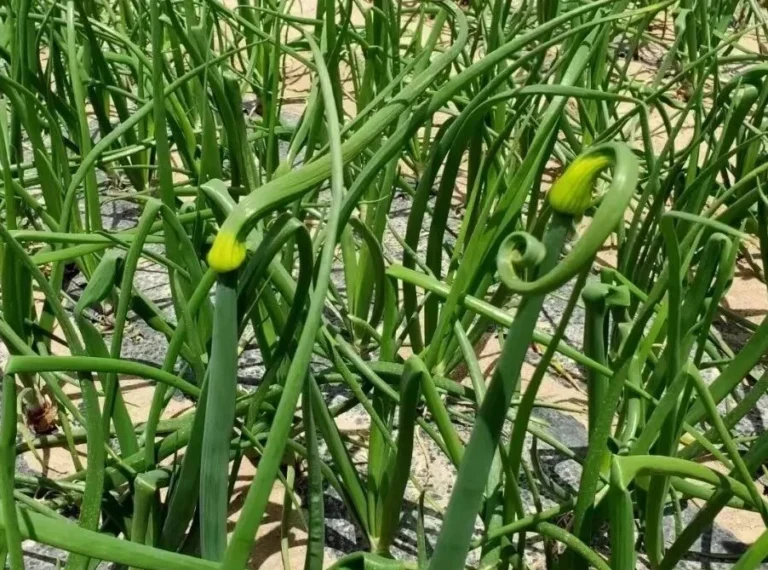
Q: I see a thick, hard stem coming out of the center with a flower bud. Is that good?
A: No, that is called “Bolting.” It means the onion was stressed (usually by cold snaps) and decided to reproduce by making seeds instead of making a bulb.
Once an onion bolts, the bulb stops growing and the center becomes hard and woody. It will not store.
- Immediate Action: Cut the flower stalk off. Harvest that onion immediately and eat it for dinner tonight (chop around the hard center). Do not try to cure or store it.
- Read More: Can you prevent it? Why did it happen? Read our full breakdown: Why Is My Onion Flowering.
What onion problems did you face this year? Let me know in the comments below — I read every single one.