When is the exact right time to plant tomatoes?
For cold and temperate climates, the window is tight: plant 1 to 2 weeks after your last expected frost date, once nighttime air temperatures reliably stay above 45°F (7°C).
For hot climates, the spring window is wider, allowing you to plant 1 to 8 weeks after the last frost to beat the summer heat. A second fall crop can also be planted 12 to 14 weeks before the first winter freeze.
However, the best planting date isn’t the same for everyone. If you rely on a single, generic calendar date you find online, you are taking a massive risk.
- If you plant too early in cold soil, your young tomatoes will suffer from severely stunted root growth.
- If you plant too late, especially in warmer climates, the plants will hit the mid-summer heat wall—where temperatures over 85°F (29°C) cause pollen to become non-viable—before they are large enough to set a massive harvest.
Your ideal timing depends on your climate zone and your personal risk tolerance. That’s why I created The Planting Key’s Dual-Baseline Tomato Calendar—a unique system that gives you two options: Aggressive Strategy (for a head start) or Safe Strategy (for guaranteed results).
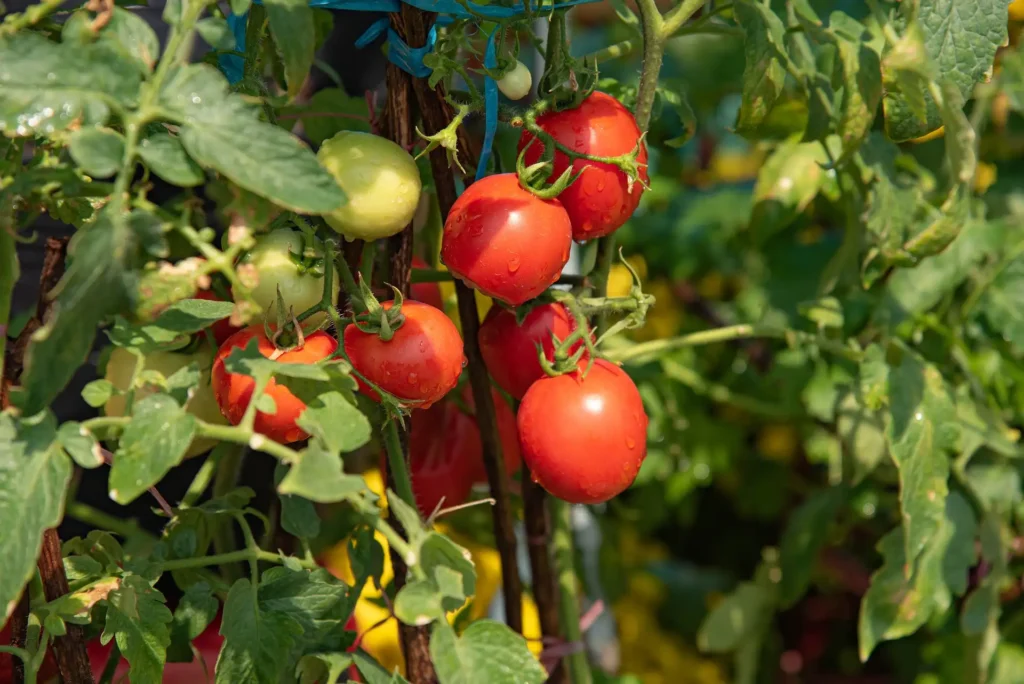
The Best Time to Plant Tomatoes by Zone
The best time to plant tomatoes depends entirely on your climate’s core challenge. This is why the planting rule changes depending on your region.
- For most gardeners in temperate or cold climates (Zones 4-6), the general rule is to plant in early spring, 1 to 2 weeks after your last expected frost date. This guideline is confirmed by experts at universities like University of New Hampshire. Because your growing season is squeezed by winter on both ends, you cannot afford to wait; you must plant as soon as the nighttime air is safely above 45°F (7°C).
- For gardeners in hot climates (Zones 7-9), the strategy is different. The spring frost ends much earlier, giving you a wider planting window of 1 to 8 weeks after your average last spring frost date, following guidance from hot-climate experts like the Texas A&M AgriLife Extension. The ultimate goal here is to get plants established early enough so they can fully mature before the intense mid-summer heat arrives and stops production.
Tomato Planting Calendar (USDA Zones 4-9)
Understanding the Dual-Baseline Tomato Calendar
Traditional planting calendars often provide just a single date, ignoring a critical fact: different gardeners have different goals. Some aim for the earliest possible harvest and are willing to protect their plants from frost or heat, while others prefer a stress-free approach that ensures a stable yield.
The Planting Key’s Dual-Baseline Methodology™ offers key planting dates for two distinct styles—Aggressive and Safe—to match your risk tolerance. Since the logic differs for spring and fall, please review the descriptions below to choose the strategy that best fits your gardening style.
For Spring Planting:
- Aggressive: For gardeners who want to get a head start. This involves planting earlier and being prepared to protect young plants from potential late frosts.
- Safe: For gardeners who prefer a cautious approach. This means waiting an extra week or two to ensure nighttime temperatures consistently stay above 45°F (7°C), minimizing the risk of cold damage and fruit deformities (like catfacing) to your new seedlings.
For Fall Planting (Zones 6-9):
- Aggressive (Heat-Avoidance Strategy): For gardeners who prefer waiting until temperatures are more moderate to reduce heat stress on young seedlings. This involves delaying your start date, which requires being prepared with protective measures against a sudden early frost.
- Safe: For gardeners who prioritize a guaranteed harvest. This means planting earlier in the season to ensure crops are fully mature before the first frost of autumn arrives.
Accuracy is my priority. The key planting dates below are calculated based on representative Aggressive and Safe frost date baselines established for each zone. Because your garden’s microclimate may vary, I strongly recommend that you verify your local frost dates for the most accurate timing. Learn My Methodology & Find a Frost Date Tool Here.
Tomato-Specific Timing Rules
Spring Planting
The dates provided are for transplanting seedlings outdoors. As a true warm-season crop, tomatoes have zero tolerance for frost. My dates are intentionally set safely after the average last frost date (1-2 weeks for Zones 4-6; 1-8 weeks for Zones 7-9) to ensure the soil has warmed sufficiently. (Remember: if starting seeds indoors, I suggest sowing them 6-8 weeks before your chosen transplanting date).
Fall Planting (Zones 6-9)
In warmer and transitional climates, a second fall crop is your secret to a massive late-season yield. To ensure a successful harvest before the first killing frost, I calculate these dates by working backward. According to the Texas A&M AgriLife Extension, fall tomatoes should be planted approximately 12 to 14 weeks before the average first fall freeze date.
Pro tip: Fall crops generally do better when started from transplants rather than seeds. I always recommend buying the largest transplants possible; their root systems will spread faster, helping them survive late summer heat and produce fruit sooner.
Why No Fall Planting in Zones 4-5? (The Plant Math & The 55°F Wall)
You’ll notice fall planting is marked as N/A for these colder zones. This is due to a combination of planting math and plant biology.
First, the math: A fast-growing tomato variety needs about 60 days to reach maturity (DTM), plus at least another 3-4 weeks to yield a meaningful, continuous harvest. That is why Texas A&M recommends counting back 12-14 weeks from your first fall frost. In Zones 4 and 5, counting back 14 weeks from an early October frost lands you in late June—which is practically the same time you are planting your spring crop! There simply isn’t a distinct “second” season.
Second, the biology: Even though the actual killing frost might not arrive until October, the University of Missouri notes that tomato pollen tube growth slows dramatically when nighttime temperatures drop below 55°F (13°C). In Zones 4 and 5, September nights frequently plunge below this threshold. Any late-planted tomato attempting to set its main fall crop in late August or September will simply drop its flowers as the cold nights arrive. Your best strategy in the North is to focus entirely on maximizing a single, continuous Spring planting.
The “Overlap” Secret: Why Fall Tomatoes Start in the Summer
You might look at the calendar below and notice something shocking: in zones like 6 or 7, the spring and fall planting windows are incredibly close. For example, you might transplant spring tomatoes in mid-May, and the fall planting window opens just over a month later in late June! How does that make sense when the spring crop is just starting to grow?
This highlights the biggest misconception about fall planting. A “fall crop” doesn’t mean waiting for your spring plants to die, clearing the bed, and starting over. By late summer, your spring-planted tomatoes are often exhausted—battling early blight, pest pressure, and severe heat stress.
Fall planting is actually a strategic succession planting. You transplant a brand-new, vigorous batch of seedlings in mid-summer (in a different spot in your garden). These young plants establish their roots during the heat, so by the time your spring plants are exhausted and ready to be pulled in late August, your fresh plants are perfectly positioned to deliver a massive, healthy harvest in the crisp autumn air. Furthermore, because daylight hours rapidly decrease in the fall, plant growth slows down—meaning you must strictly adhere to these early late-summer planting dates to beat the shrinking daylight.
The Planting Key’s Dual-Baseline Tomato Calendar
| USDA Zone | Spring Planting(Aggressive) | Spring Planting(Safe) | Fall Planting(Aggressive) | Fall Planting(Safe) |
| Zone 4 | May 16 – May 23 | May 22 – May 29 | N/A | N/A |
| Zone 5 | May 7 – May 14 | May 14 – May 21 | N/A | N/A |
| Zone 6 | May 4 – May 11 | May 15 – May 22 | Jul 12 – Jul 26 | Jun 26 – Jul 10 |
| Zone 7 | Apr 13 – Jun 1 | Apr 15 – Jun 3 | Jul 30 – Aug 13 | Jul 19 – Aug 2 |
| Zone 8 | Mar 30 – May 18 | Apr 12 – May 31 | Aug 3 – Aug 17 | Jul 24 – Aug 7 |
| Zone 9 | Mar 7 – Mar 14 | Mar 25 – Apr 1 | Aug 24 – Sep 7 | Aug 4 – Aug 18 |
✔ Accuracy is my priority. The key planting dates in this calendar are calculated based on representative Aggressive and Safe frost date baselines established for each zone. Because your garden’s microclimate may vary, I strongly recommend that you verify your local frost dates for the most accurate timing. Learn My Methodology & Find a Frost Date Tool Here.
Understanding the Planting Windows
Spring Planting: Seizing the Warm Season
Spring planting is the standard for tomatoes. The goal of my spring strategy is to get healthy seedlings established in the garden after all frost danger has passed, but well before the peak heat of mid-summer arrives.
As noted by the NC State Extension, most tomatoes grow and produce best when daytime temperatures range from 70 to 80°F (21-27°C), and night temperatures fall between 60 and 70°F (15-21°C). Getting an early (but safe!) start gives your plants plenty of time to develop strong root systems and begin flowering during this ideal temperature window. The lengthening days and warming spring soil provide the perfect conditions for vigorous, uninterrupted growth.
Fall Planting: Your Second Harvest Opportunity
In warmer and transitional climates (Zones 6 and above), a second “fall” crop is a fantastic opportunity to double your yield.
By transplanting heat-tolerant, shorter-season varieties in mid-to-late summer, you take advantage of the thoroughly warmed soil for rapid root establishment. Once the intense summer heat begins to wane, your sturdy plants will be perfectly positioned to set a heavy crop of fruit during the more moderate, favorable temperatures of early autumn.
The Danger Zone: Why Temperature Extremes are the Enemy
While tomatoes love the sun, their ability to successfully pollinate and set fruit is highly sensitive to temperature extremes. The “danger zone” for your harvest isn’t just about blistering heat—it’s about any significant deviation from their comfort zone.
- Extreme Heat: Intense summer heat can severely derail your harvest. As detailed by researchers at the University of Missouri, when daytime temperatures exceed 85°F (29°C) or nighttime temperatures stay above 70°F (21°C), tomato pollen becomes “tacky” and non-viable. This makes successful pollination nearly impossible, often causing the stressed plant to simply drop its blossoms without producing fruit. The plants will survive, but production will stall until the weather cools.
- Persistent Cold: On the other end of the spectrum, cold weather is equally damaging. The same University of Missouri research explains that when nighttime temperatures drop below 55°F (13°C), pollen viability drops and the growth rate of the pollen tube slows down dramatically. The flower simply ages and drops off before the slow-moving pollen tube can reach the ovary to complete fertilization. Furthermore, Cornell University points out that if young transplants are exposed to cold temperatures early in the season (60-65°F during the day and 50-60°F at night), they become highly susceptible to “catfacing”—a physiological condition resulting in deeply misshapen fruit. This is exactly why I stress waiting until nights are consistently above 45°F (7°C) before moving plants outdoors.
Key Factors & Advanced Strategies
The Secret Signal: Ideal Soil, Air, and Humidity
Beyond the planting calendar, a thermometer and a hygrometer are your most trustworthy tools. Understanding these key thresholds will empower you to give your tomatoes exactly what they need.
- Ideal for Seed Germination: If you are starting your own plants indoors, Cornell notes that the absolute best temperature range for rapid tomato seed germination is between 75-90°F (24-32°C).
- Optimal for Growth: Once established in the garden, tomatoes are happiest when daytime air temperatures are between 70-80°F (21-27°C).
- The Hidden Metric – Humidity: Temperature isn’t the only factor in fruit set; humidity plays a massive, often-ignored role. The ideal relative humidity for tomato pollination is between 40% and 70%. If the air is too dry, pollen fails to stick to the stigma. If humidity rises above 70%, the pollen cannot shed properly from the stamen.
Advanced Pollination & Season Extension Tactics
When weather conditions are marginal, you don’t have to just leave it to chance.
- The “Blossom Set Spray” Nuance: Many gardeners buy hormone-based “blossom set sprays” to prevent blossom drop. However, as noted by Colorado State University, these sprays are only effective for setting fruit during cool weather conditions. If your flowers are dropping because the daytime temperatures are reaching 90°F (32°C), hormone sprays are completely useless.
- The “Midday Shake”: Because tomatoes are self-pollinating and rely on vibration to move pollen within the flower, you can dramatically improve fruit set during challenging weather by gently shaking or vibrating the main stems of your plants at midday, when the dew has dried and the pollen is most easily released.
Your Next Step: Learn How to Grow
Ready to grow? Read my pillar guide:
How to Grow Tomatoes: The Complete Guide from Seed to Harvest