Hello, I’m Yun, founder of The Planting Key. You have planted the right variety, watered them all season, and watched the leaves grow tall. Now, you are facing the final hurdle: The Harvest.
This is where many gardeners stumble. Harvest too early, and the bulbs will be small and won’t store. Harvest too late, and they can rot in the ground.
But unlike carrots or potatoes where you have to guess what’s happening underground, onions give you a clear, dramatic signal when they are done. They simply “fall over.”
Here is my complete guide on reading this signal, harvesting without damage, and curing your onions so they last all winter.
Quick Answer: When are onions ready to harvest?
Onions are ready when the plants “faint.”
- The Signal: Wait until the green tops weaken at the neck and fall over naturally.
- The Timing: Harvest when one-third to one-half (33% to 50%) of your crop has fallen over.
- The Action: Stop watering immediately. Pull them on a dry day.
- Post-Harvest: They must be “cured” (dried) for 2-4 weeks before storing.
The “Falling Over” Signal: It’s Not Dead!
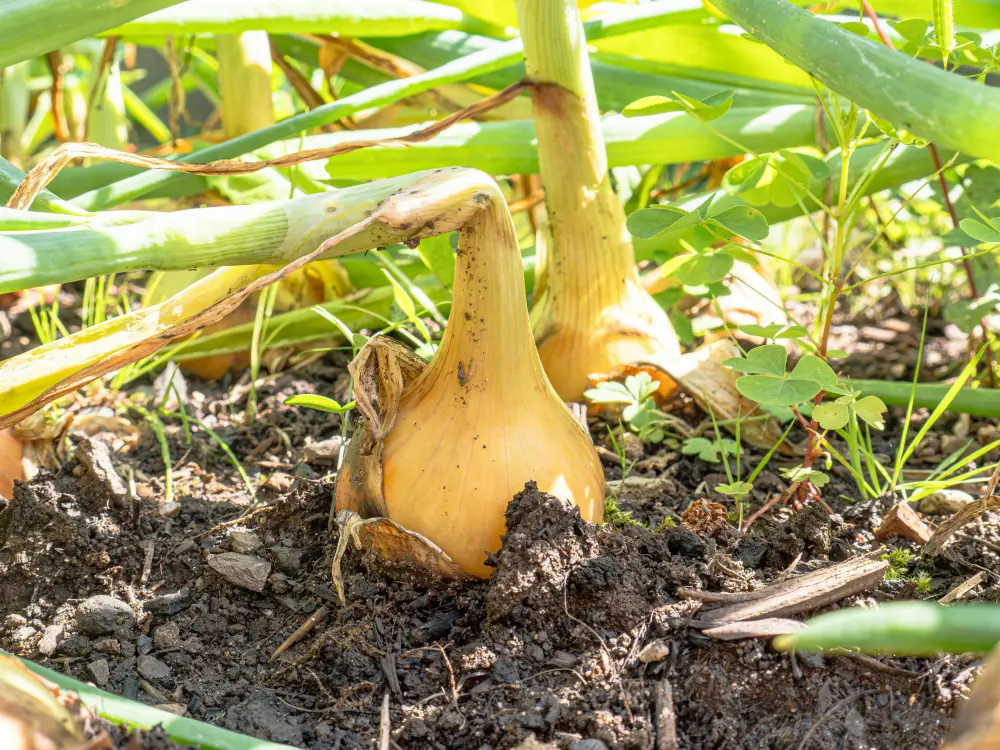
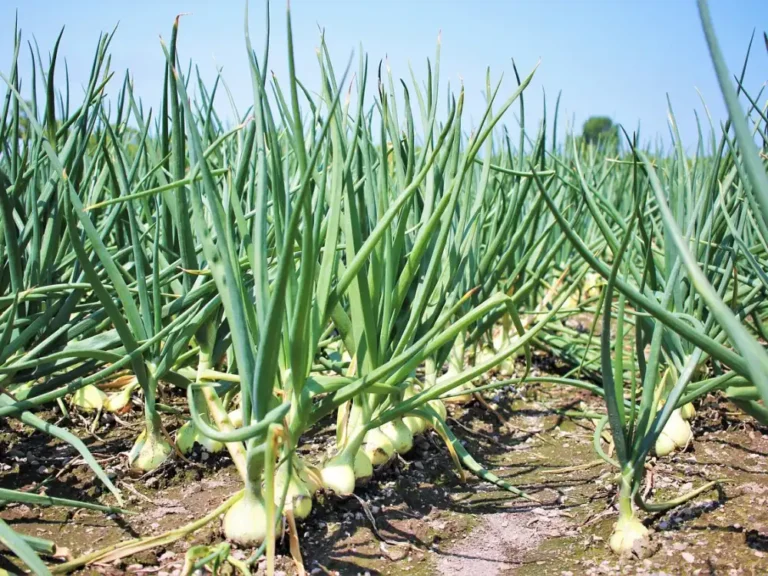
In mid-to-late summer, you will walk out to your garden and see your onion tops lying on the ground. Don’t panic. Your onions are not dying; they are maturing.
The Biology: When an onion finishes its life cycle, the “neck” (the stem just above the bulb) softens. It becomes weak because the plant stops sending energy to the leaves and starts sealing off the bulb for dormancy. Once the neck softens, the heavy green leaves act as a lever and topple over. However, if the neck feels thick and hard, or you see a flower stalk emerging, your onion is “bolting” and won’t fall over naturally. Read my guide on Why Is My Onion Flowering to learn how to harvest these immediately.
Michigan State University explains that onions are mature when they stop producing new leaves—the neck shrinks and leaves fall over naturally. Interestingly, onion bulbs continue to gain size and weight until the leaves are completely dry.
- Green Leaves = Still Growing: If the tops are standing straight up, the bulb is still swelling.
- Fallen Tops = Finishing: The bulb has reached its maximum potential.
When to Pull: The One-Third Rule
You don’t have to harvest the second the first onion falls. In fact, you shouldn’t.
The Strategy:
- Wait for the Signal: Wait until one-third to one-half (33% to 50%) of your onions have fallen over. Penn State Extension recommends this timing as the optimal harvest window. I personally prefer to wait until closer to half (50%) for maximum bulb maturity and storage potential, but one-third is the safe minimum.
- Stop Watering: This is critical. As soon as you see this signal, stop all watering. Utah State University emphasizes that excess water as the crop matures delays curing and causes storage problems. You want the soil to dry out.
- The “Knock Down” (Discouraged): Some gardeners gently push remaining upright tops over to speed maturity, but Michigan State University research shows this practice can result in bulbs that are not fully mature and may sprout in storage. It’s better to wait naturally.
- Harvest: After a few dry days, when most tops are down and yellowing, lift them. (Note: This yellowing is a natural sign of maturity. If your leaves are turning yellow before falling over, check my guide on Why Are My Onion Leaves Turning Yellow to rule out disease.)
Zone-Specific Harvest Timing
While the “Falling Over” sign is universal, when it happens depends on your zone and variety.
- South (Zones 7-9):
- Timing: Late Spring / Early Summer (May – June).
- Variety: Short-Day Onions (e.g., Vidalia types).
- Note: These are “Sweet Onions.” They have higher water content and do not store well (1-2 months max). Eat them first!
- North (Zones 4-6):
- Timing: Mid-to-Late Summer (July – August).
- Variety: Long-Day Onions (e.g., Storage types).
- Note: These are “Storage Onions.” With proper curing, they can last 6-8 months.
Step-by-Step: How to Harvest
Rule #1: Be Gentle. Onions look tough, but they bruise easily like apples. A bruised onion will rot.
- Loosen: Use a garden fork to gently loosen the soil next to the row. Do not stab the bulb!
- Lift: Grasp the neck and lift. If it resists, loosen the soil more.
- Shake: Gently brush off big clumps of soil. Do not wash them. Water is the enemy of storage.
- Clip Roots (Optional): You can trim the dirty roots now or later, but leave the tops on for curing. Note: When you eventually remove the tops after curing, ensure you cut about 1 to 2 inches above the bulb (not flush with the bulb) to prevent rot from entering the neck.
The Secret to Long Storage: “Curing”
You cannot throw a fresh onion straight into the pantry. It will mold. You must “cure” it, which simply means drying the outer skins and sealing the neck.
Method 1: Field Curing (Dry Climates) If you have a run of dry, sunny weather (no rain forecast for days):
- Lay the onions on top of the soil.
- Pro Tip: Arrange them like shingles. Lay the leafy tops of one row over the bulbs of the next row. This protects the bulbs from “sunscald” (sunburn).
Method 2: Rack Curing (Humid Climates) If you live in a humid area or rain is coming, cure them under cover.
- Location: A porch, garage, or shed. It must be dry, shady, and breezy.
- Setup: Spread onions in a single layer on screens or racks. Air must circulate around the bulb.
- Time: 2 to 4 weeks.
- Temperature Matters: Keep the curing area between 75-80°F with good air circulation. If you need faster results, Penn State Extension notes that commercial growers use forced warm air (90°F) for 4-5 days, but this requires specialized equipment.
The “Done” Test: Your onion is cured when:
- The neck is tight and dry (like wire), not moist.
- The skin is papery and rustles when touched.
- The stem doesn’t slide when you pinch it.
Storage After Curing
Once your onions are fully cured and the necks are sealed, proper storage is key to longevity:
Temperature: Store at 32-40°F in a dark, dry location. Penn State Extension notes that onions maintained at 32°F with 65-70% relative humidity can be stored for 1-8 months, depending on variety.
Check Regularly: Inspect your stored onions monthly. Use any that show softening or sprouting first.
Remember: Sweet onions (short-day varieties) have higher water content and will only last 1-2 months even under ideal conditions. Storage onions (long-day varieties) can last 6-8 months when properly cured and stored.
Troubleshooting Harvest Problems
Your Next Step
Now that your harvest is safely curing on the racks, you have completed the cycle! But remember, the quality of next year’s harvest starts with the planning you do this winter.
Missed the planting window this year? Mark your calendar now: When to Plant Onions