Gardening in USDA Zone 8 offers a fantastic, long growing season, making it a prime location for a “split-season” or dual potato harvest. However, it comes with a massive challenge: The Spring Heat Wall.
In Zone 8, the transition from mild spring to scorching summer happens almost overnight. If you wait too long to plant your spring crop, your potatoes will hit the 85°F (29°C) temperature wall in late May or June—the exact temperature where potato tubers completely stop growing.
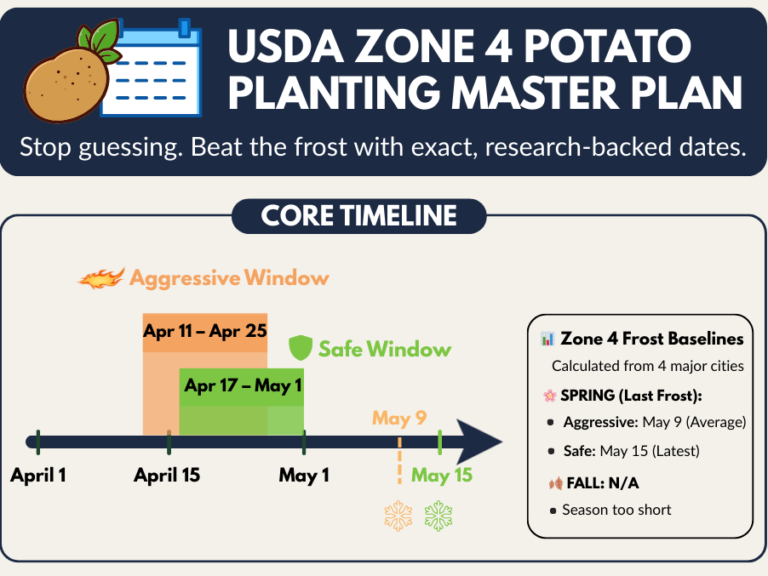
To help you perfectly thread the needle between late spring frosts and early summer heat, I have developed a Free Printable 2026 Potato Planting Cheat Sheet (PDF) tailored specifically for Zone 8.
🔍 Not sure if you are in Zone 8?
Microclimates can trick you! Before you download this calendar, I highly recommend double-checking your exact zip code on the Official USDA Plant Hardiness Zone Map. (It takes 5 seconds!)
(Check the preview below, and scroll down to have the high-res printable version sent to your inbox!)

Beating the Zone 8 “Heat Wall”
Most generic planting guides tell southern gardeners to simply wait until “after the last frost.” In Zone 8, that advice will drastically reduce your yield. You must get your potatoes in the ground before the last frost to ensure they reach maximum size before the brutal summer heat arrives.
To provide maximum accuracy, my printable chart utilizes The Planting Key’s Dual-Baseline Methodology™. It removes the guesswork by calculating your exact planting windows using local climate data and the official Texas A&M AgriLife Extension guidelines (planting 4 to 6 weeks before the last spring frost, and 14 to 16 weeks before the first fall frost).
Your Exact Zone 8 Planting Windows (Spring & Fall)
Zone 8 relies heavily on strategic timing. The Aggressive strategy is highly rewarded in the spring, while careful heat management is mandatory for the fall.
The Spring Crop (Beating the Heat Wall)
Your average last frost (Mar 23) and latest last frost (Apr 5) dictate a very early start.
- Spring Planting (Aggressive): Feb 9 – Feb 23
- The Strategy: This is the highly recommended window for Zone 8. By planting in mid-February, your potatoes will sprout just as the major frost threats recede. They will have months to grow huge before the intense June heat shuts them down. Just keep frost blankets handy for unexpected March cold snaps!
- Spring Planting (Safe): Feb 22 – Mar 8
- The Strategy: If you hate monitoring the weather, this is your window. Frost risk is practically eliminated, but you are racing against the clock. You must use fast-growing, early-season potato varieties, or the summer heat will stunt your yield.
The Fall Crop (The Winter Storage Run)
Following the Texas A&M timeline, to get a fall harvest, you must plant exactly 14 to 16 weeks before your first fall frost. In Zone 8, this means plunging your seed potatoes into the hot July soil!
- Fall Planting (Safe): Jul 10 – Jul 24
- The Strategy: This guarantees your crop will fully mature before the earliest expected Halloween frosts (Oct 30). Because you are planting in the brutal July heat, applying a thick layer of straw mulch immediately is mandatory to cool the soil and prevent seed rot.
- Fall Planting (Aggressive): Jul 20 – Aug 3
- The Strategy: This pushes your planting slightly later to let the absolute worst of the summer heat break before the sprouts emerge. However, you risk the plants being killed by an average November 9 freeze before they reach maximum size.
Transparency is my priority. Verify the exact climate data and representative cities behind these Dual-Baselines on the My Research Data page.
Best Potato Varieties for Zone 8
Just like Zone 7, a successful split-season in Zone 8 requires matching the right potato genetics to the right season.
- ‘Dark Red Norland’ or ‘Yukon Gold’ (Spring Crop): These early-to-mid season varieties (65-90 days) are absolute lifesavers in Zone 8. They grow rapidly, ensuring a massive harvest of fresh potatoes before the soil gets dangerously hot.
- ‘Kennebec’ or ‘Red Pontiac’ (Fall Crop): To maximize your winter food supply, use mid-to-late season varieties (80-100 days) for your fall planting. Planted in July, these have just enough time to develop thick, protective skins in the cooling October soil, making them perfect for long-term winter storage.
Download Your Free Zone 8 Printable Calendar
Stop letting the spring heat wall stunt your potatoes. Enter your email below to unlock my Printer-Friendly PDF library. I’ll send this high-resolution Zone 8 Potato Master Plan straight to your inbox, so you can print it out and keep it right where you need it—taped to your seed bin or clipped to your garden planner.
Curious about how I calculate these dates? Read my full breakdown of the Dual-Baseline Potato Planting Methodology (Zones 4-9) to learn why your microclimate matters.