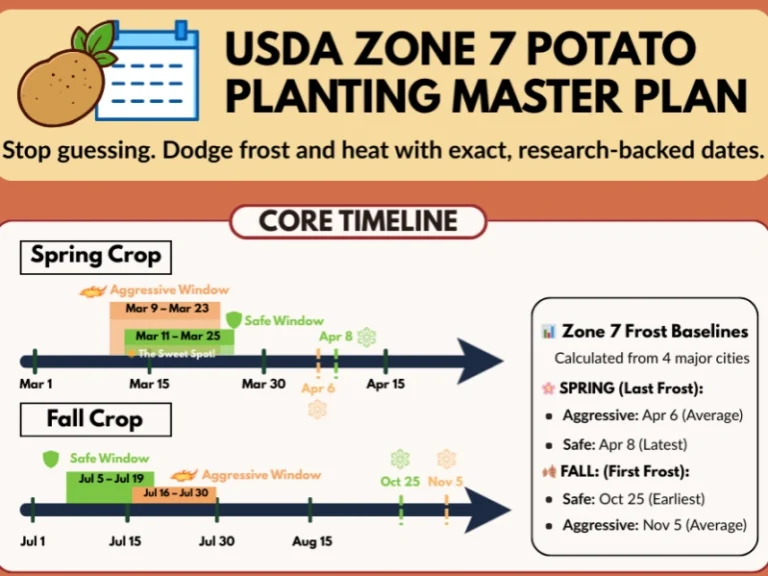
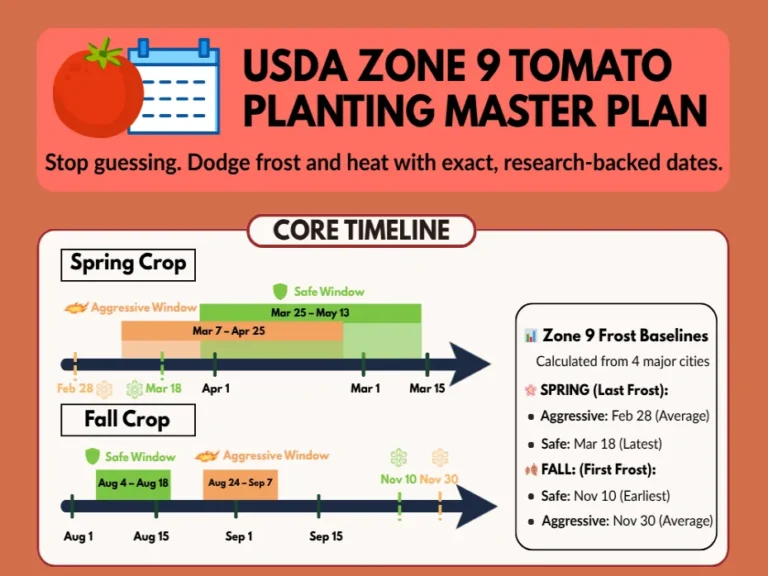
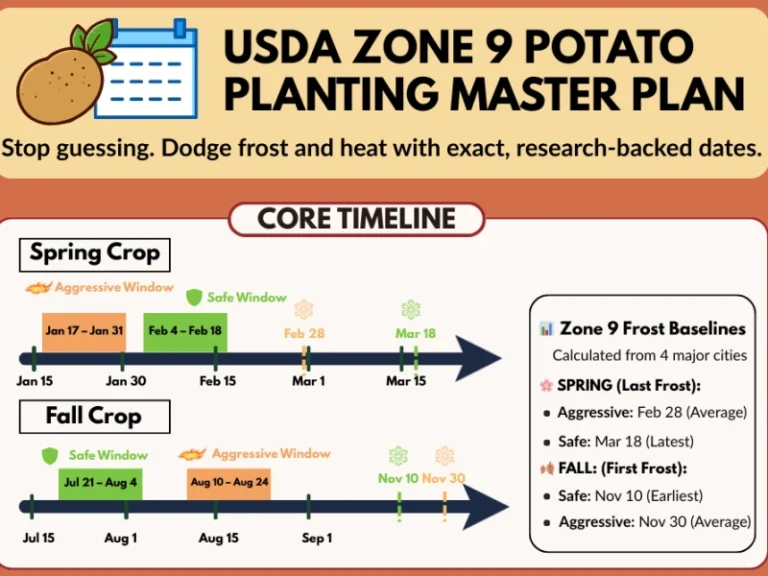
Gardening in USDA Zone 6 is often described as the “sweet spot,” but for potatoes, it presents a unique “Transition Zone Trap.” Because your climate sits right in the middle, you face threats from both ends of the spectrum: lingering late-spring frosts in early May, followed closely by sweltering mid-summer heat that shuts down tuber production.
If you guess your planting dates, you risk either freezing your emerging sprouts or starving your plants during the summer heatwave.
To help you hit the perfect window, I have developed a Free Printable 2026 Potato Planting Cheat Sheet (PDF) tailored specifically for Zone 6. It calculates your exact planting dates to maximize your harvest before the summer heat arrives.
🔍 Not sure if you are in Zone 6?
Microclimates can trick you! Before you download this calendar, I highly recommend double-checking your exact zip code on the Official USDA Plant Hardiness Zone Map. (It takes 5 seconds!)
(Check the preview below, and scroll down to have the high-res printable version sent to your inbox!)
Avoiding the Zone 6 “Transition Zone Trap”
In Zone 6, planting potatoes on standard, generic dates often leads to disappointing yields. You need a timeline that is aggressive enough to beat the July heat, but safe enough to survive the unpredictable May frosts.
To provide maximum accuracy, my printable chart utilizes The Planting Key’s Dual-Baseline Methodology™. It removes the guesswork by calculating your exact Spring planting windows using local climate data and the official Cornell University timeline (direct seeding 2 to 4 weeks before the last spring frost). This gives you two distinct planting windows depending on your risk tolerance.
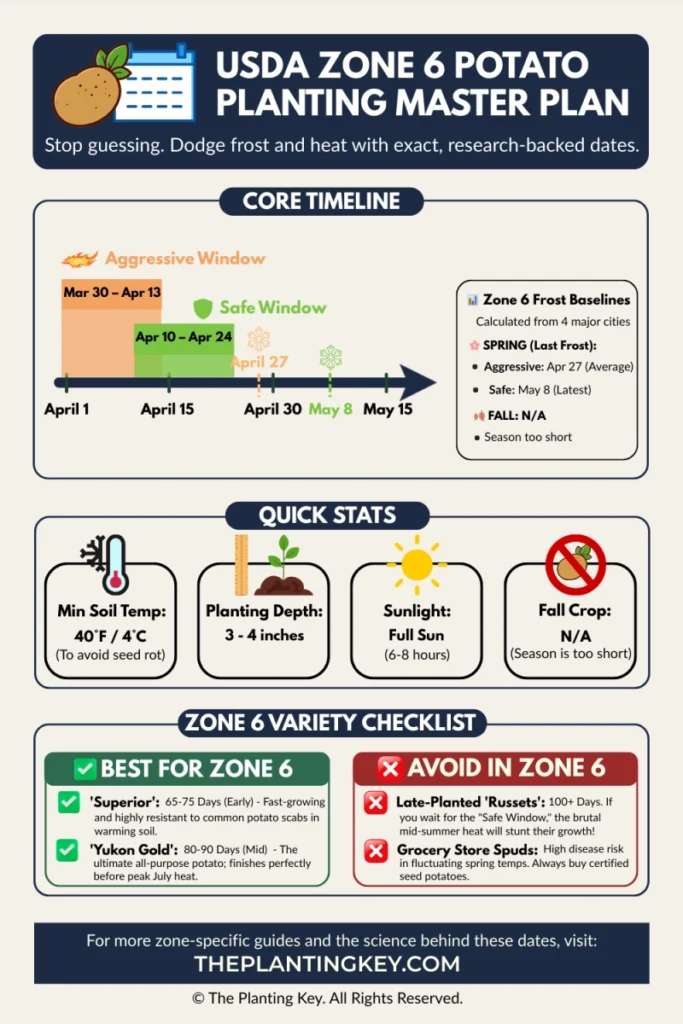
Your Exact Zone 6 Frost Baselines & Planting Windows
Because Zone 6 relies on a robust main season before the deep heat sets in, your entire focus must be on optimizing the Spring crop. A Fall potato crop is generally not applicable (N/A) in this zone because the growing window between the peak summer heat and the first autumn frost is simply too short.
The Spring Crop (Balancing Frost and Heat)
- Spring Planting (Aggressive): Mar 30 – Apr 13
- The Baseline: Calculated from the average last frost date (April 27).
- The Strategy: This is for gardeners who want to ensure a massive harvest before the mid-summer heat sets in. By planting in late March or early April, your plants get a huge head start. However, you must keep frost blankets on standby, as a late April frost is highly likely.
- Spring Planting (Safe): Apr 10 – Apr 24
- The Baseline: Calculated from the single latest last frost date (May 8).
- The Strategy: This is the guaranteed survival window. By waiting until mid-to-late April, the soil is reliably warm and the risk of a killing frost destroying your above-ground foliage is practically zero.
Transparency is my priority. Verify the exact climate data and representative cities behind these Dual-Baselines on the My Research Data page.
Best Potato Varieties for Zone 6
With a reliable medium-length growing season, Zone 6 is excellent for almost all early and mid-season varieties.
- ‘Yukon Gold’ (Mid-Season, 80-90 Days): The ultimate all-purpose potato. It thrives perfectly in the Zone 6 timeline, maturing fully in the warm (but not yet scorching) days of early July.
- ‘Kennebec’ (Mid-to-Late Season, 80-100 Days): A heavy-yielding classic that grows vigorously. If you use the Aggressive Planting window, Kennebecs have plenty of time to size up beautifully before the deep summer heat arrives.
- ‘Superior’ (Early-Season, 65-75 Days): True to its name, this variety is highly resistant to common potato scabs and matures incredibly fast, making it a stress-free option for the Safe Planting window.
Download Your Free Zone 6 Printable Calendar
Stop falling into the transition zone trap. Enter your email below to unlock my Printer-Friendly PDF library. I’ll send this high-resolution Zone 6 Potato Master Plan straight to your inbox, so you can print it out and keep it right where you need it—taped to your seed bin or clipped to your garden planner.
Want to understand the science behind these calculations? Read my complete guide on the Dual-Baseline Potato Planting Methodology to see how soil temperature dictates your success.